

CONTACT US

PETITHAUSRC7155563
PetitHaus: Innovative housing solution that helps low/medium income earners access affordable, highly efficient qualitative living with convenience and unparalleled cost effectiveness.
Affordable Homeownership

SNEAK PEEK
Lagos keeps building roads… yet traffic keeps getting worse? Not just worse, but also more expensive, more time-consuming, and more exhausting. The solution to congestion was simply “more roads.” Lagos should have solved this problem decades ago.
But it hasn’t. And that’s where the real question begins: What if traffic is not a road problem… but an economic one?
Suggesting…
When most people think about city planning, they think about approvals, permits, and building regulations. But that’s surface-level. City planning is not just about controlling development.
It’s about structuring how a city works economically. Because beneath every road, every estate, every zoning map… is a system. Where each planning layer influences the next, creating a hierarchy of dependencies:
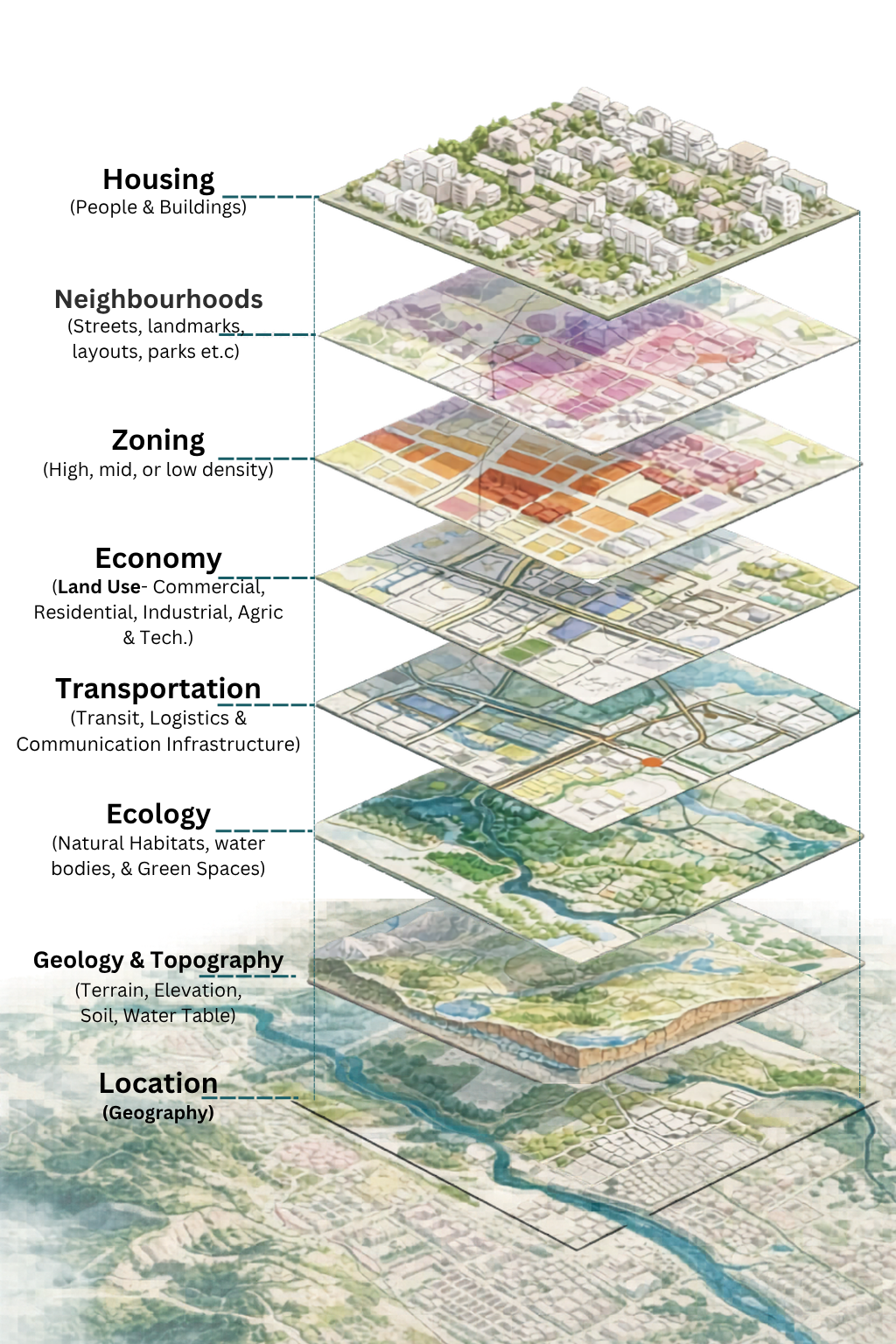
Land-use planning categorizes city land into residential, commercial, agricultural, and other zones. This layer directly determines the economic activities possible within the city. How land is allocated and used influences job creation, business operations, and the overall economic health of the urban area.
Urban planning is a complex, dynamic system, and this integrated perspective is essential for effective policy-making, as interventions at one layer ripple through others, affecting the entire urban fabric and economic vitality.
If you follow that chain closely, one thing becomes clear: Transportation is not just movement. It is economic infrastructure.
Lagos, Nigeria’s economic powerhouse, presents a vivid example of how infrastructure and planning shape urban development. Much of Lagos’s critical infrastructure (ports, airports, and bridges) was built during the 1970s oil boom when Lagos was both the economic and national capital. This period of heavy investment laid the foundation for its current economic dominance.
However, Lagos now faces challenges because its infrastructure development has not kept pace with its economic growth and population demands. The city's continued success depends on reinvesting in transportation infrastructure and adopting innovative planning models to maximize land use efficiency and reduce congestion.
But congestion is not the problem; it is only the symptom. The real issue is we’ve built a city where economic activities are too far apart. Where people must travel long distances:
And when movement becomes mandatory, traffic becomes inevitable.
For years, the default response has been predictable. Expand roads. Build bridges. Increase capacity. But there’s a hidden dynamic at play… Induced demand.
While wider roads may seem like straightforward solutions to traffic congestion, they often exacerbate car dependency and urban sprawl. Instead, investing more in integrated transportation infrastructure, in increased infrastructure and resources for rapid transit (BRT), light rail, trams (Lagos red & blue light rails), and pedestrian-friendly pathways, supports transit-oriented development (TOD) and sustainable urban growth.
Now Step Back for a Second…
What if people didn’t need to travel as far in the first place? Would traffic even exist at this scale? This is where the conversation shifts.
From: “How do we move people faster?” To: “How do we reduce the need for movement altogether?”
TOD focuses on creating compact, walkable neighbourhoods centered around high-quality transit options. This model reduces the need for car travel by ensuring residents can access workplaces, shops, and services within a short walk or bike ride, or via efficient mass transit.
Transit-Oriented Development (TOD) is built on a simple but powerful idea: Design cities where people can live, work, and access opportunities within 5–15 minutes.
This is where Transit-Oriented Development changes everything. Not as a transport strategy, but as an economic development strategy.
It is equally not just about adding BRT lanes, rail systems, tram lines, or bus stops. TOD is about something deeper. It is transportation infrastructure as an integrated economic system. Where:
In cities like Lagos, where informal and inefficient transport (systems) dominates, TOD offers a path to formalize and improve transit services. By embedding reliable mass transit options into neighbourhoods, governments can phase out unsafe, overcrowded minibuses and taxis, improving commuter experience and safety.
Implementing TOD in systems like this are equally challenging and rewarding… For example,
Convincing residents to shift from private cars to public transit is a major hurdle. Many prefer the comfort, convenience, and perceived safety of personal vehicles over often unreliable public options.
However, if transit systems consistently save commuters significant time, many will embrace the change due to the value of regained productive time.
Informal transport unions and poorly managed transit systems complicate efforts to improve public transportation. TOD provides governments leverage to set new standards, improve service quality, and introduce competition among transport providers, raising overall commuter satisfaction.
By enabling seamless movement of people and goods, TOD stimulates economic exchanges that drive GDP growth and tax revenues. Compact neighbourhoods with accessible transit create a fertile environment for businesses to thrive.
This directly improves housing affordability and accessibility as, with increased and improved economic activities,
Which means that a functional rental market becomes naturally supported by the system.
Lagos’s sprawling, low-density development model, characterized by single-family homes on large plots, wastes scarce land and infrastructure resources.
Shifting to compact, mixed-use land use maximizes the economic potential of limited urban land, enabling better revenue generation and sustainable growth. This cascades to residents as:
Reduced travel times, lower pollution levels, and improved access to amenities contribute to better health, productivity, and overall well-being for urban residents.
There’s a catch. As stated earlier above, "Every layer influences the next.” TOD can not work in isolation.
You can’t fix transportation without fixing land use. You can’t improve housing without improving economic access. And you can’t build infrastructure without aligning it with how land is used.
So what does Lagos need to do differently?
The real constraint is not land, but how we use it. Lagos’ housing problem, when you look closely, is a land use problem. More specifically, an (economic) land use problem. And because of this inefficiency in how land is used, Lagos suffers from what you could call "rich man planning in a low-income, high-density city.”
And it comes at a cost. This sprawled development model is unsustainable in high-density, low-income urban areas. Instead, cities must adopt income-responsive planning that considers the financial realities and needs of all residents.
Instead of separating uses, TOD integrates them, and, instead of spreading the city out, it compacts it. In a TOD system, instead of forcing movement, it reduces it:
This creates a self-reinforcing economic loop.
By integrating residential, commercial, and recreational uses and creating compact urban forms, cities can harness their land’s full economic potential. This approach reduces sprawl, lowers infrastructure costs, and supports efficient transit systems.
When land is underutilized, economic activity is limited, cash flow is restricted, and investment becomes less attractive. Dead Land → Dead Potential → Dead Cash Flow.
And just like we’ve seen in the rental market, everything connects as...
Low cash flow = low investor interest = low supply.
Developing functional, digitized land administration systems will help capture and convert land value into economic productivity. Proper land management tools enable better planning, taxation, and investment decisions.
City planning is much more than zoning and building approvals; it is a dynamic framework that integrates geography, ecology, transportation, land use, and economic activity into a living urban system.
For cities like Lagos, embracing transit-oriented development and compact land use models is crucial to unlocking economic potential, reducing congestion, and enhancing residents’ quality of life.
By prioritizing transportation infrastructure connected with thoughtful land use planning, cities can foster vibrant, productive neighbourhoods where economic opportunities are accessible within minutes. This sustainable approach to urban development ensures that cities not only grow but thrive economically and socially.
Here’s what that loop looks like:
Better transit → Improved access → More business activity → Higher productivity → Stronger cash flow → More investment → Better infrastructure
… And then the cycle continues. Most importantly, cities must start seeing city planning as an economic system and not only as a regulatory process. A city is not valuable because of how it looks; it is valuable because of how it works. And Transit-Oriented Development offers Lagos something more than better transport.
It offers a new way to think about land, housing, infrastructure, and ultimately… economic growth.
01.

02.
Category
Discover insights into creating affordable homeownership with PetitHaus.




.avif)
.avif)