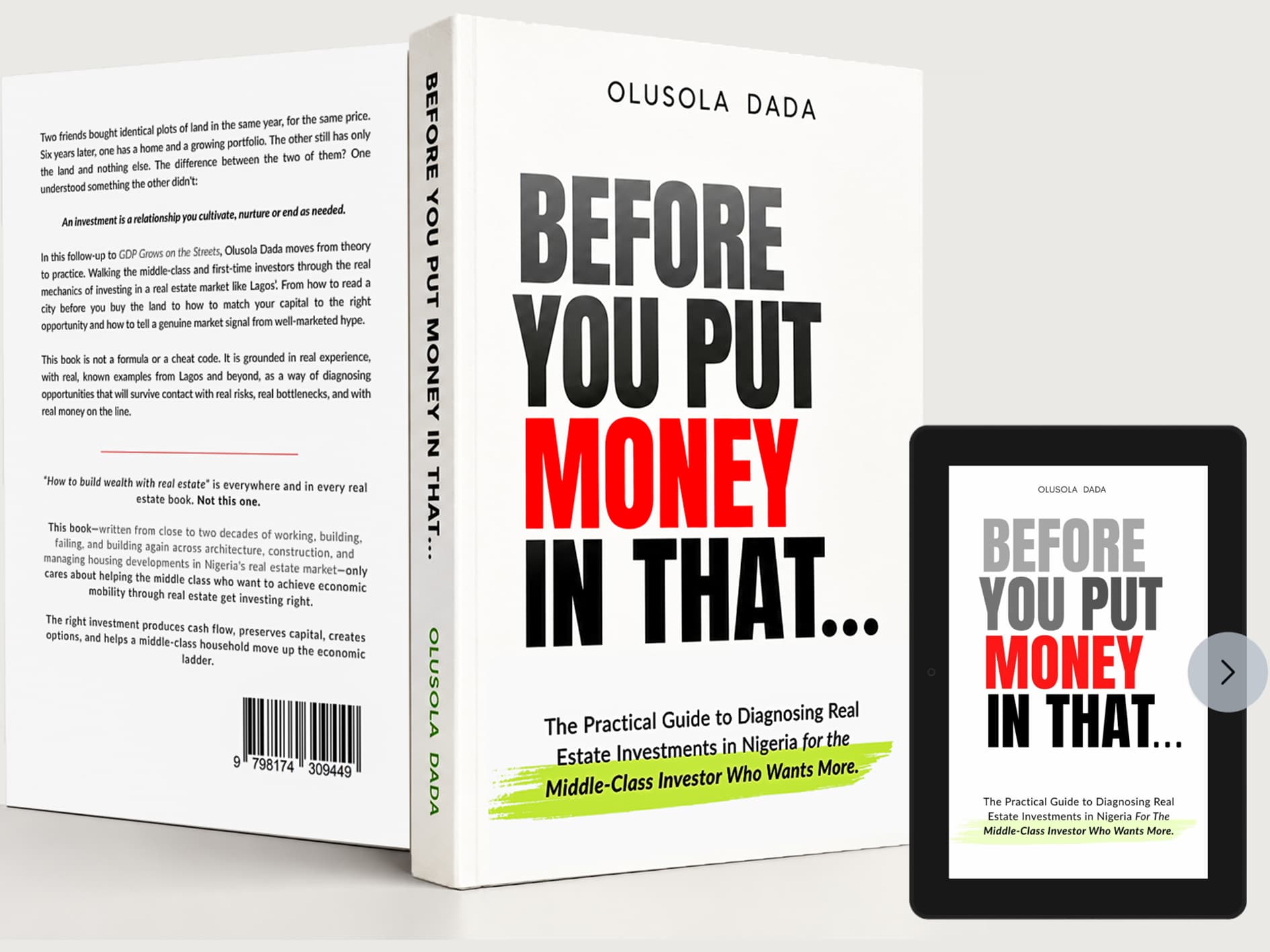
Stop guessing with your money.
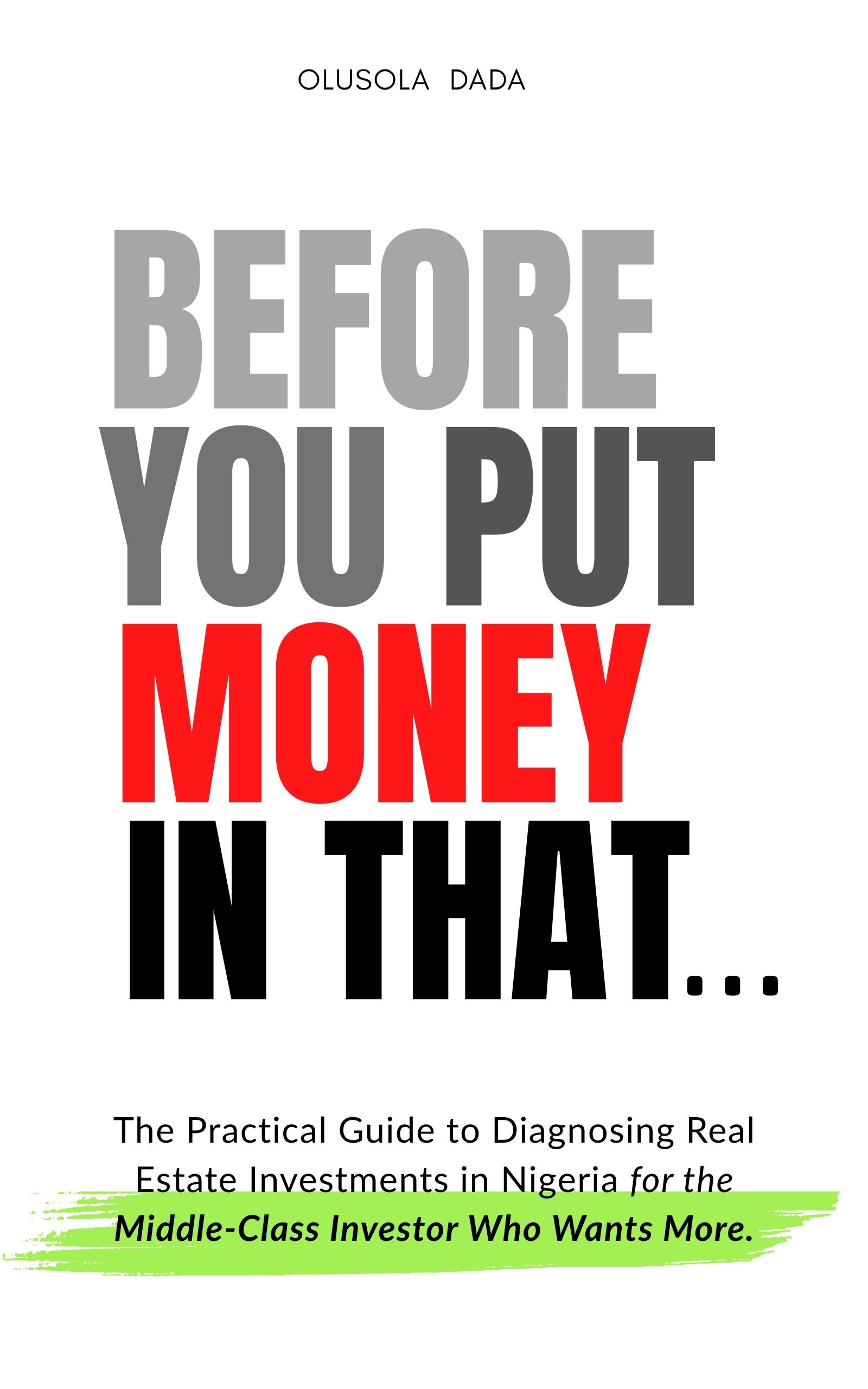
Before You Put Money In That… takes you deeper beyond land banking, location, and the marketing hype, to know for yourself and decide whether a piece of land, a building, or a deal is worth the value someone is asking you to pay for.
A Practical Guide to Diagnosing Real Estate Investments in Nigeria, for the Middle-Class Investor Who Wants More.
Available internationally as ebook & paperback across multiple stores.


What's inside?
Before You Put Money In That… gives you a working method for reading a market, trends, a corridor that will appreciate, and even a business partner, before your capital ever moves.
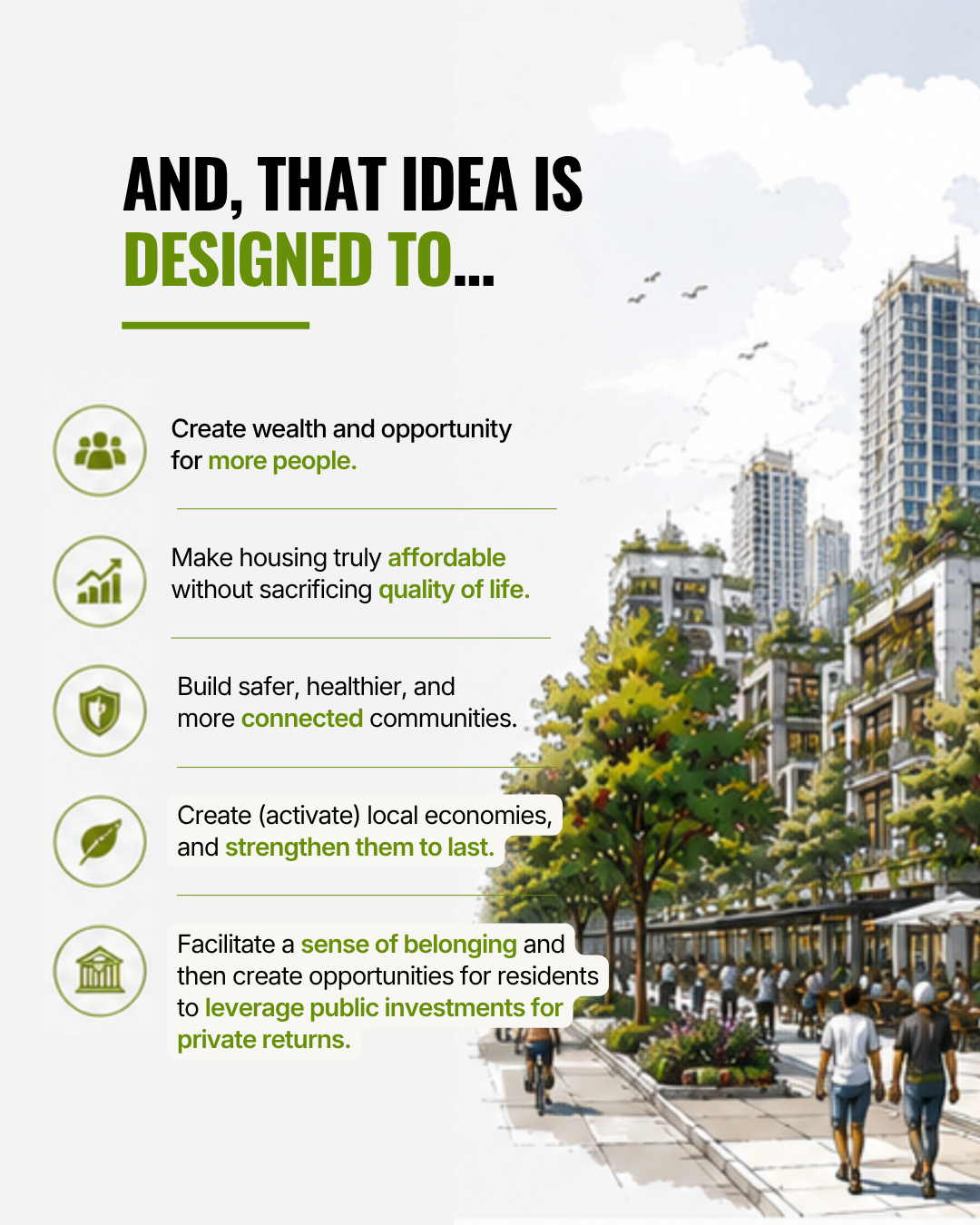
Investing is not the same as owning property. And not every real estate investment involves owning a property.
Investment is the relationship between your capital, how well you understand the risks it comes with, and the outcomes you want.
— Before You Put Money in That
"What makes the book particularly engaging is the language. You do not need to be an economist or urban planner to follow the conversation. The examples feel familiar, relatable, and grounded in the realities of everyday life. This is a book that makes you pause, look again at the world around you, and see the economic potential hidden in ordinary places and moments. Informative, accessible, and thought-provoking..."

Damilola Moyosore
Elementary Montessori Guide
BETA reader.
What makes this book different?
This isn't another book on how/where to buy land on the outskirts and wait.
Before You Put Money In That… sits somewhere between urban economics, personal finance, real estate practice, and plain diagnostic method. Instead of handing you one strategy and telling you where to apply it, it teaches the reasoning that tells you whether any given strategy actually fits the specific plot, the specific capital, and the specific moment in front of you.
01
Rising price is not evidence of value.
A flyer that reads "prices to increase by month end", a billboard, and a growth-rate statistic all cost nothing to publish. This book teaches you how to read and measure the real evidence of value that is worth betting your money on.
02
The cost of an investment is never just the sale price.
A property's real cost is the sum of all it requires to turn it into a legal, bankable, and transferable leverage. The sale price is only where that sum begins.
03
Every good investment has a corresponding risk.
What makes the difference is identifying it and knowing who owns, bears, or handles it when it arises. This book teaches you how to create structures for managing risks.
This is a book about the specific, step-by-step decisions and actionable strategies that separate a real investment from a mistake, and how to make each one deliberately for individual investments no matter the location.
“How to build wealth with real estate” is everywhere and in every real estate book.
Not this one.
This book (written on lessons from close to two decades of working, building, failing, and building again across architecture, construction, and managing housing developments in Nigeria's real estate market) only cares about helping the middle class who want to achieve economic mobility through real estate get investing right.
The right investment produces cash flow, preserves capital, creates options, and helps a middle-class household move up the economic ladder.
Not this one.
This book (written on lessons from close to two decades of working, building, failing, and building again across architecture, construction, and managing housing developments in Nigeria's real estate market) only cares about helping the middle class who want to achieve economic mobility through real estate get investing right.
The right investment produces cash flow, preserves capital, creates options, and helps a middle-class household move up the economic ladder.
who is it for?
.png)
For the middle-class Nigerian planning a first move into property, or a newer investor looking to grow a modest portfolio into something larger.
First-time land buyers, diaspora investors, small business owners, civil servants, rental property owners, aspiring developers, and anyone tired of guessing whether an investment is real, fake, or just well marketed trouble waiting to happen.
READ on any device.
Beyond price and location, and if used properly, real estate is a tool for genuine cash flow and economic mobility, not simply an outcome you hope for.
Before You Put Money In That… breaks down exactly how.
.svg)
Print length
242 Pages
.svg)
Publisher
Independently Published
.svg)
Language
English
.svg)
File Size
2.2MB


Six things determine whether any real estate is worth investing in or not. And price is not one of them.
Understanding and measuring the six things is what makes the difference between an investment and an expensive mistake.
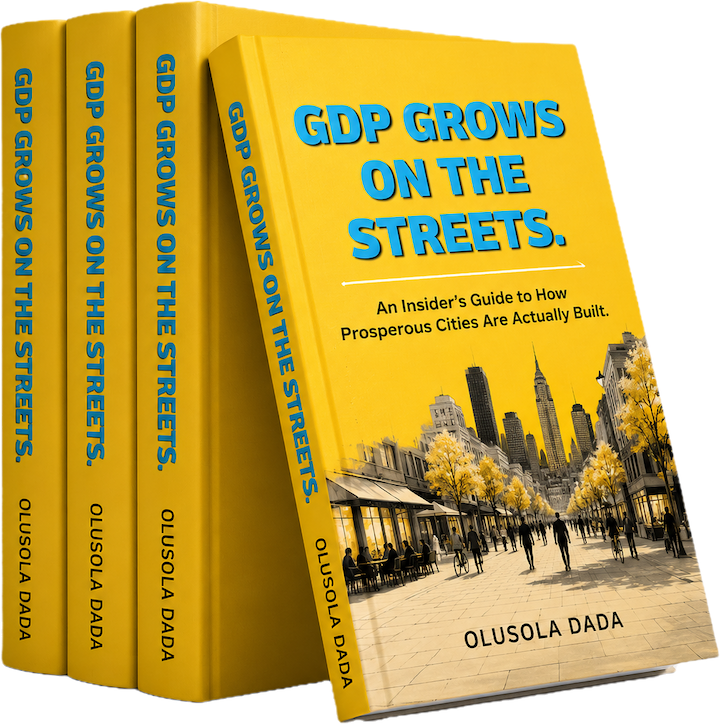
recommended for you.
best read together with before you put money in that...
Other readers also bought this book too.
?
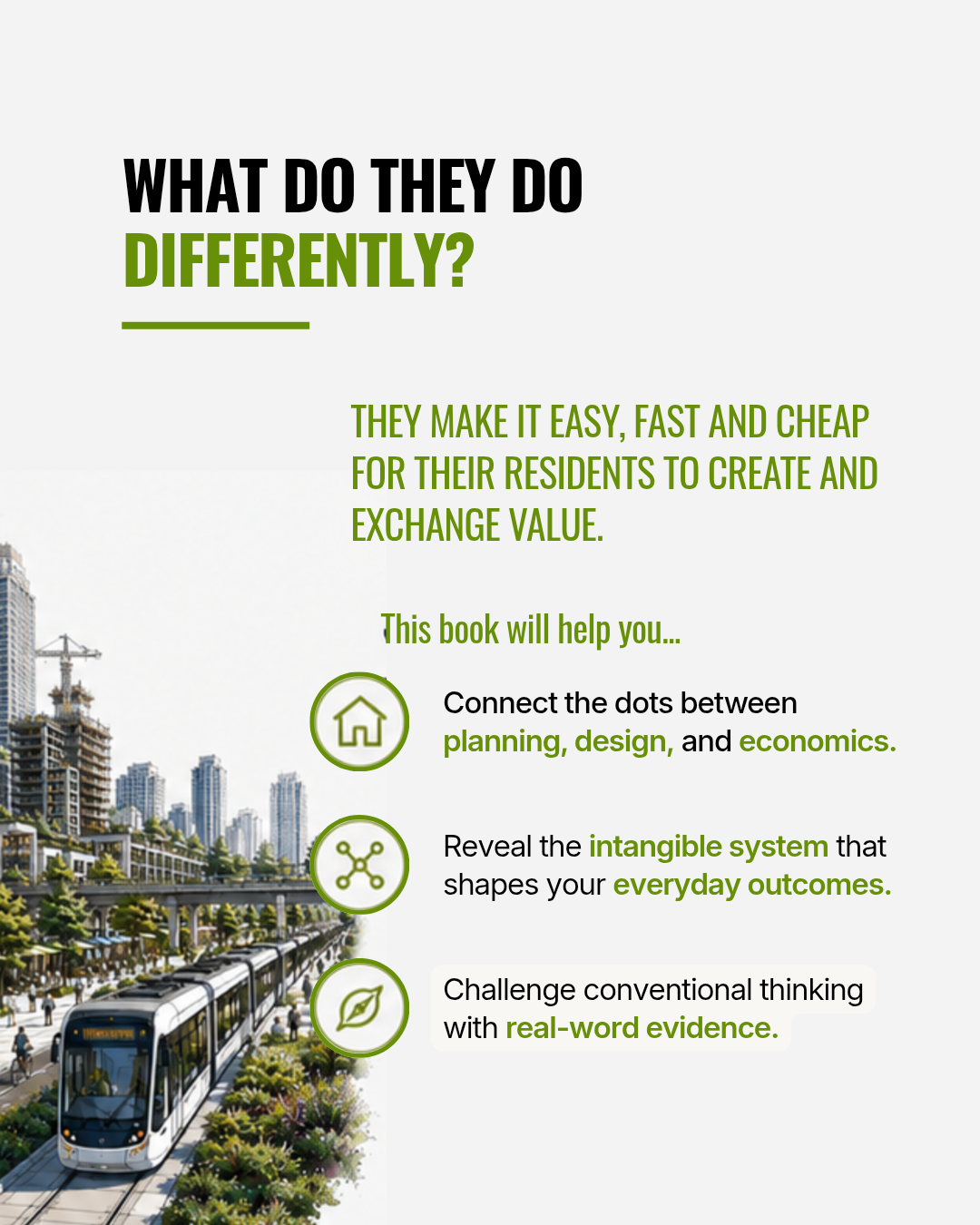
Why do two identical houses sell for wildly different prices? And what that gap actually measures about the systems around them.
?
Why do some neighbourhoods keep getting better while others quietly stall, no matter how much money is spent on them?
?
Why does cutting construction costs alone rarely fix affordability, and what the real lever turns out to be instead.
?
Why copying another city's model often fails when the economic, cultural, and spatial conditions are different.
?
What separates cities that reward genuine value creation from cities that quietly reward extraction.
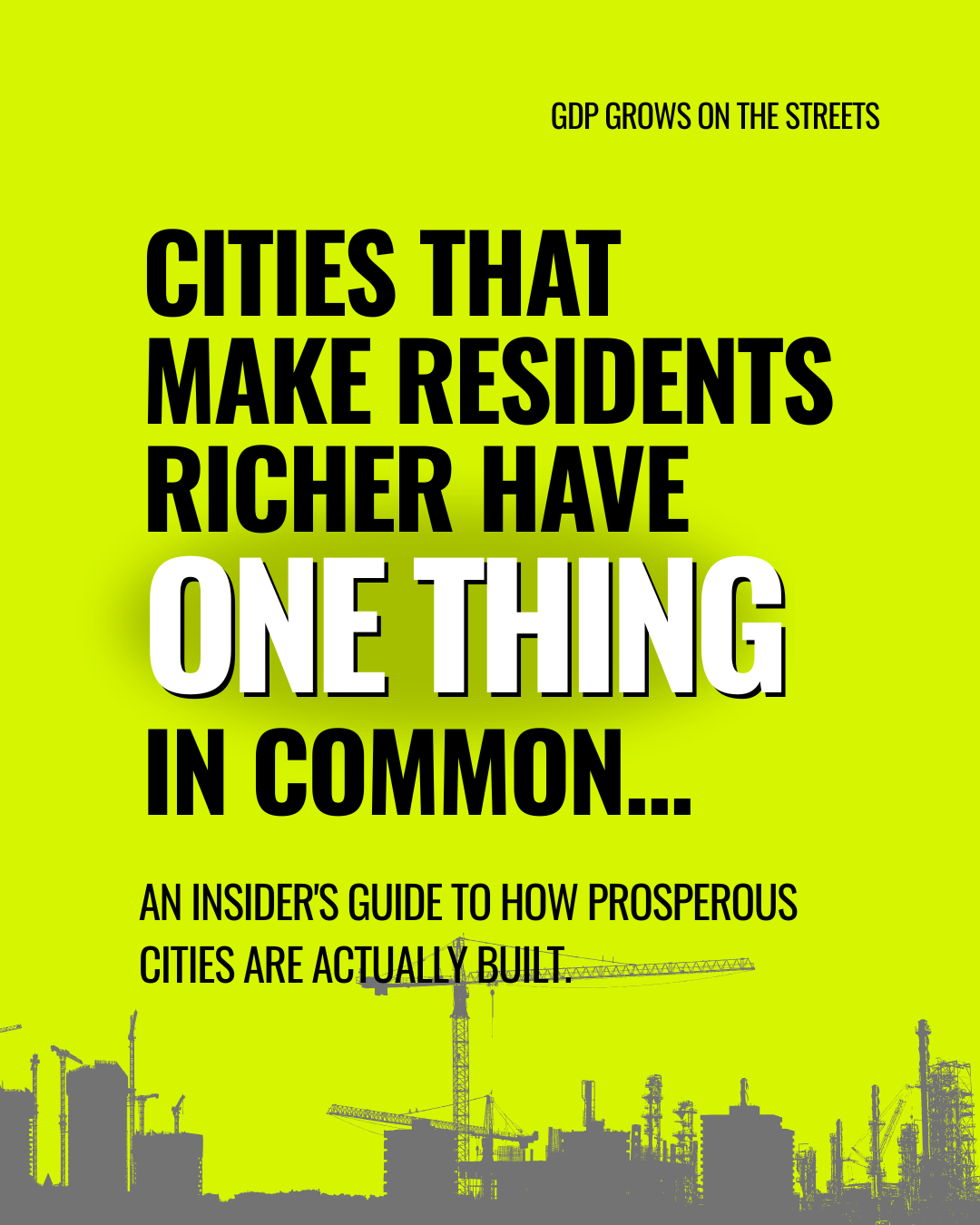
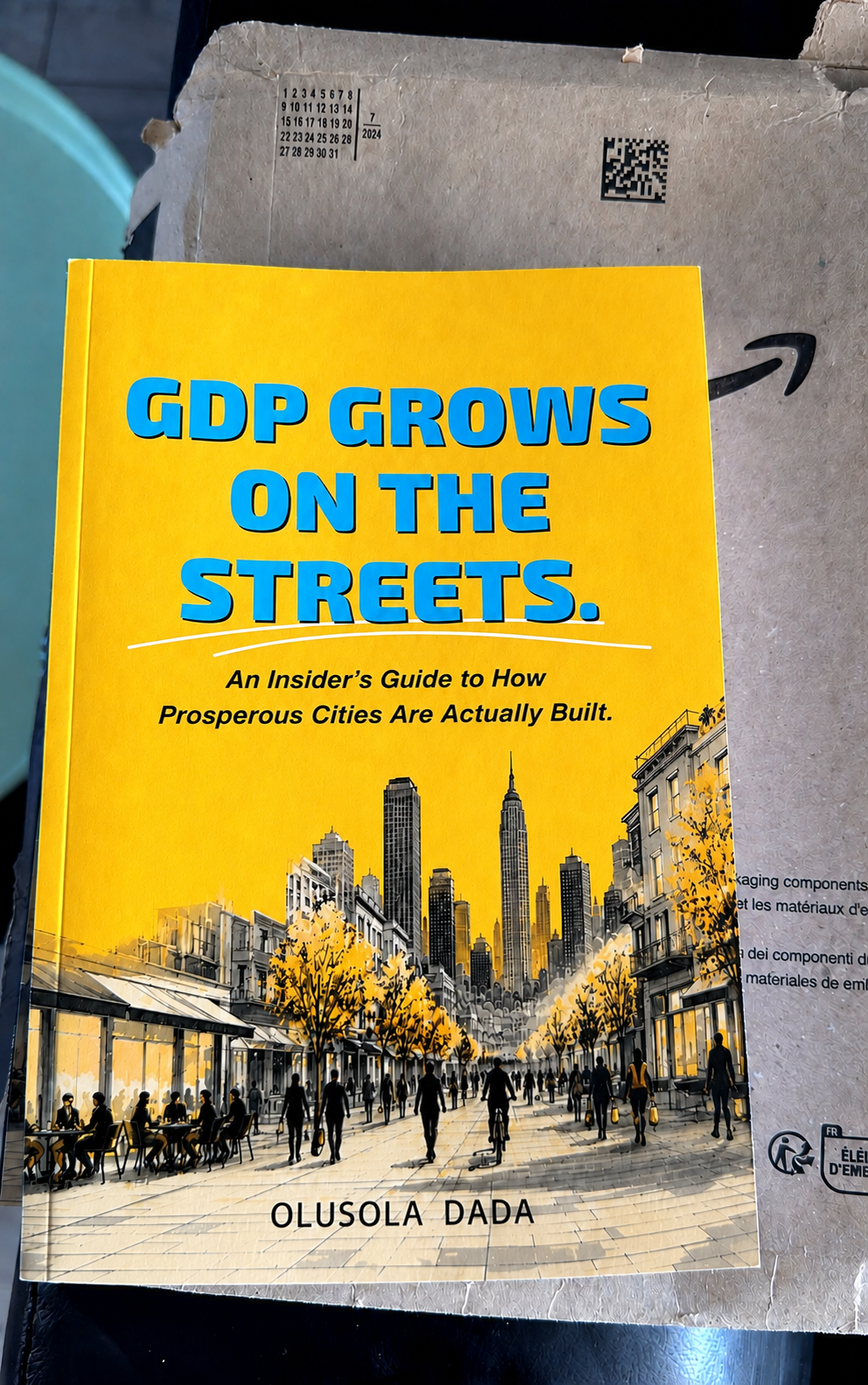
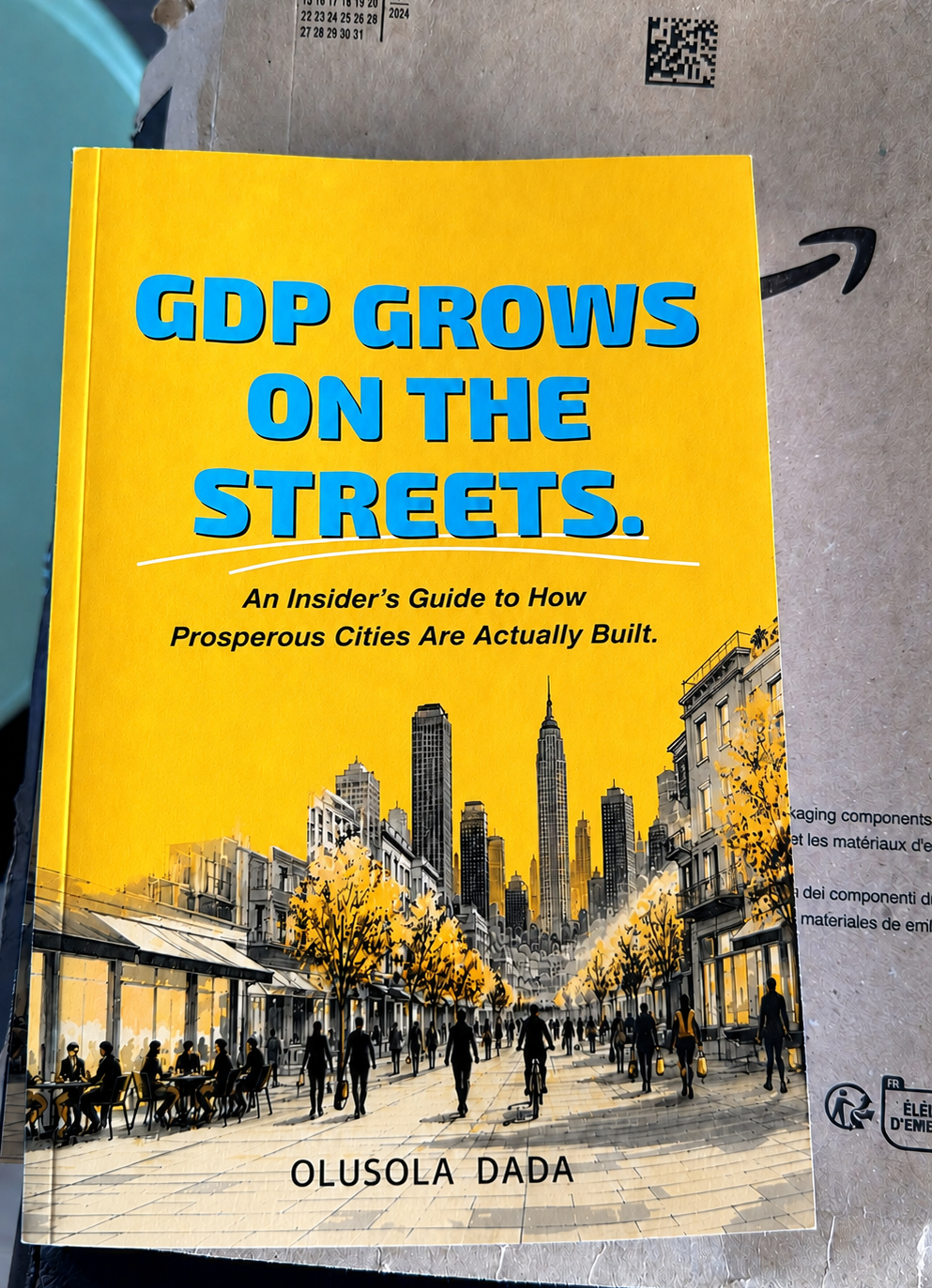
An Insider's Guide To How Prosperous Cities Are Actually Built.
Started with a 5-year old asking...
"Papa, does the city ever sleep?"
It sounded like a simple question. Trying to answer it opened another set of questions entirely.
What actually is a city? Why do some create opportunity while others make progress harder?
Why can two people in seemingly similar houses live completely different lives?
Those questions eventually became GDP Grows on the Streets.
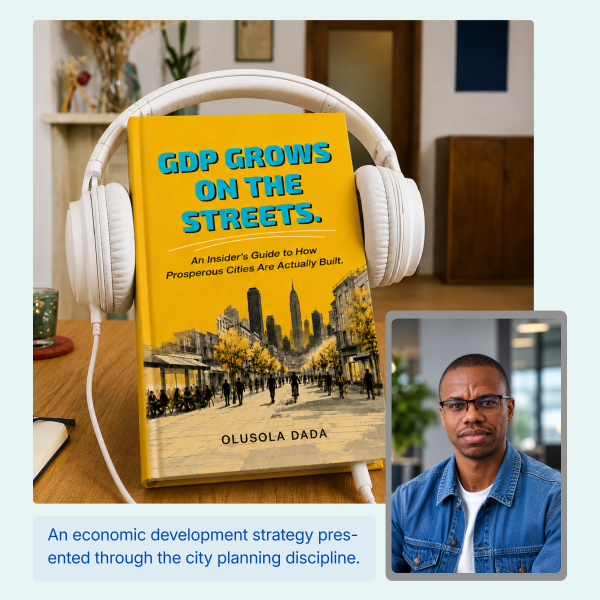
Audio Preview
WHAT MAKES THIS BOOK DIFFERENT?
This isn't another book about buildings. And it isn't a conventional economics textbook. GDP Grows on the Streets sits somewhere between urban economics, real estate, city planning, personal experience and economic development. It takes ideas that are often discussed separately and puts them into one system.
Who is It for?
For anyone who wants to understand why cities work the way they do, and the opportunities within.
ArchitectsUrban plannersDevelopersInvestorsPolicymakersEntrepreneursEconomistsReal estate professionalsStudents
... or simply everyone who has ever wondered why one place seems to help people thrive, while another makes everything harder than it needs to be.
_20260803_131704_0000.png)
Because an Introduction and a Prologue Just Won’t Cut It
Read the First Chapter, Too, for Free.
This isn’t some skimpy sample.
It’s eight full parts of GDP Grows on the Streets: An Insider's Guide to How Prosperous Cities are Actually Built, 38 pages... enough to keep you busy while you wait for your paperback to be delivered.
Long enough to keep you busy while you wait for your appointment at the planning ministry that struggles with just the right amount of dysfunction to keep things going.
Download Your PDF Sample
By clicking Download, you're confirming that you agree with our Terms and Conditions.