

CONTACT US

PETITHAUSRC7155563
PetitHaus: Innovative housing solution that helps low/medium income earners access affordable, highly efficient qualitative living with convenience and unparalleled cost effectiveness.
SNEAK PEEK
You are not wrong if you're in the market for... “How do I get ROI faster?” “How do I avoid 'unnecessary’ expenses?” “How do I reduce cost?”... You're only being smart. But pull up a chair. Let's talk.
First of all… Since, in a low-income economy like ours, it is natural to look for shortcuts.
Shortcuts are great, especially if you're either:
When you understand the mechanics behind the topic, the tips and tricks make sense. But in Nigeria’s housing and real estate market, there’s a third reality about “tips and tricks”.
Most people are not searching for ‘tips’ to understand. They are searching for 'tips n tricks' to bypass cost or make the 'quickest, safest' ROI.
And in an industry where context is everything, when you treat real estate like a game of hacks, and you're constantly chasing every
Whereas, only a few explain why those “hacks” make sense, when they make sense, and for whom they make sense… You end up like a man whose only tool is a hammer, and you see every problem as a nail.
If you want to stop chasing the next shiny thing or trying to solve deeply structural problems with fragmented information. If you want to stop speculating and start being strategic…
What you need is understanding.
Here are 5 simplifications to help shift your perspective of the mechanics of value in the industry.
One of the biggest perspective shifts people need is understanding that housing is not merely “cement and roof.”
Housing is an anchor of economic value. Housing is an economic system. A property is not valuable simply because there is a building sitting on it. Its true value lies in the rights attached to it:
Once you see housing as a long-term container of economic, financial, and social value, your mindset changes.
Approval is no longer "stress". Professionals are no longer “avoidable expenses". Documentation is no longer an “extra cost". They simply become “cost of doing business” to preserve, unlock, and legitimise the value embedded within the property.
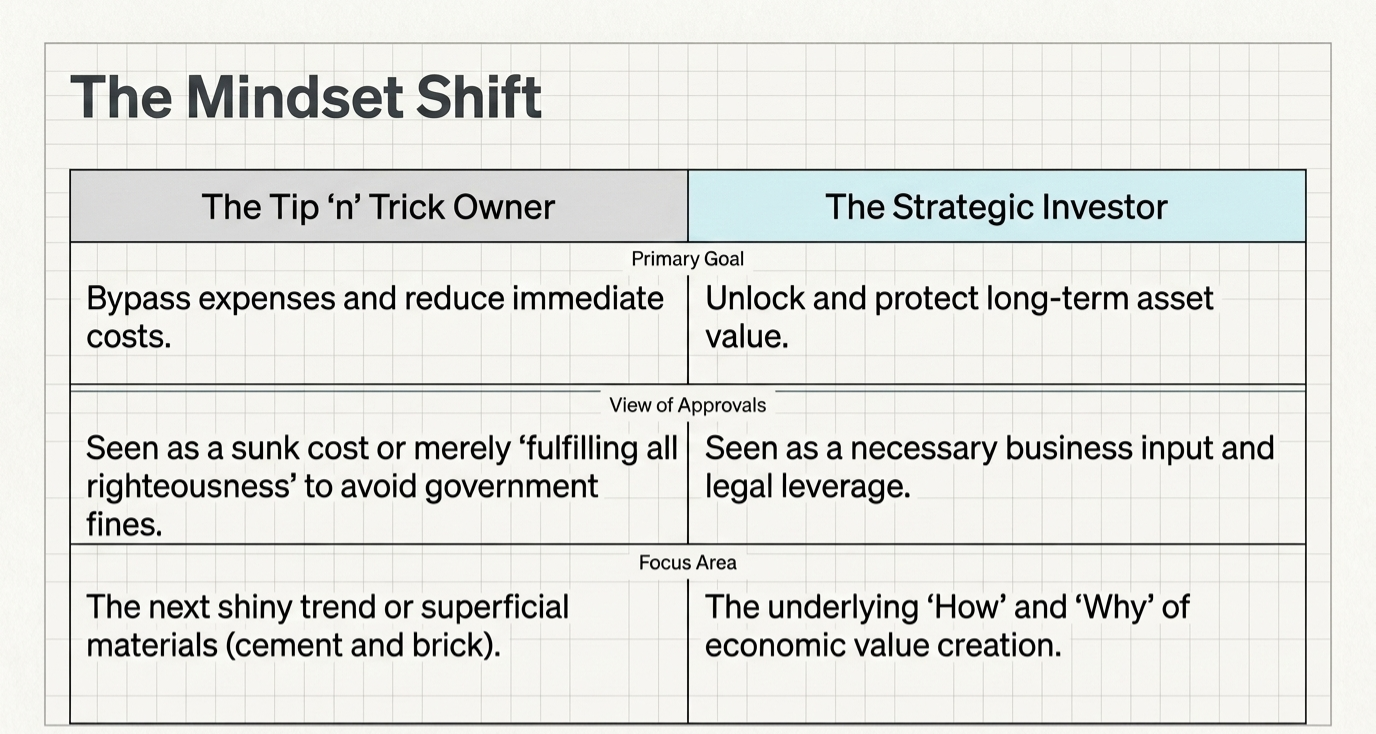
Then the conversations move beyond “Which material is cheaper?” or “Which method is faster?”... To how value is created, protected, and preserved matters more than merely what is being built.
We often focus on the building, but the real estate market is first and foremost an infrastructure market. In fact, when we say “real estate revolves around infrastructure", we… let me say, “under-simplify” the relationship.
Infrastructure is the ‘market’.
Roads | Electricity | Drainage | Transport access | Distribution systems | Economic movement.
These are what the market really sells.
Think about it. Why does a tiny plot in a premium estate cost more than a massive forest in a remote village? Land in the middle of nowhere can remain worthless for decades, but the moment a road appears, value suddenly emerges, even before a single block is laid.
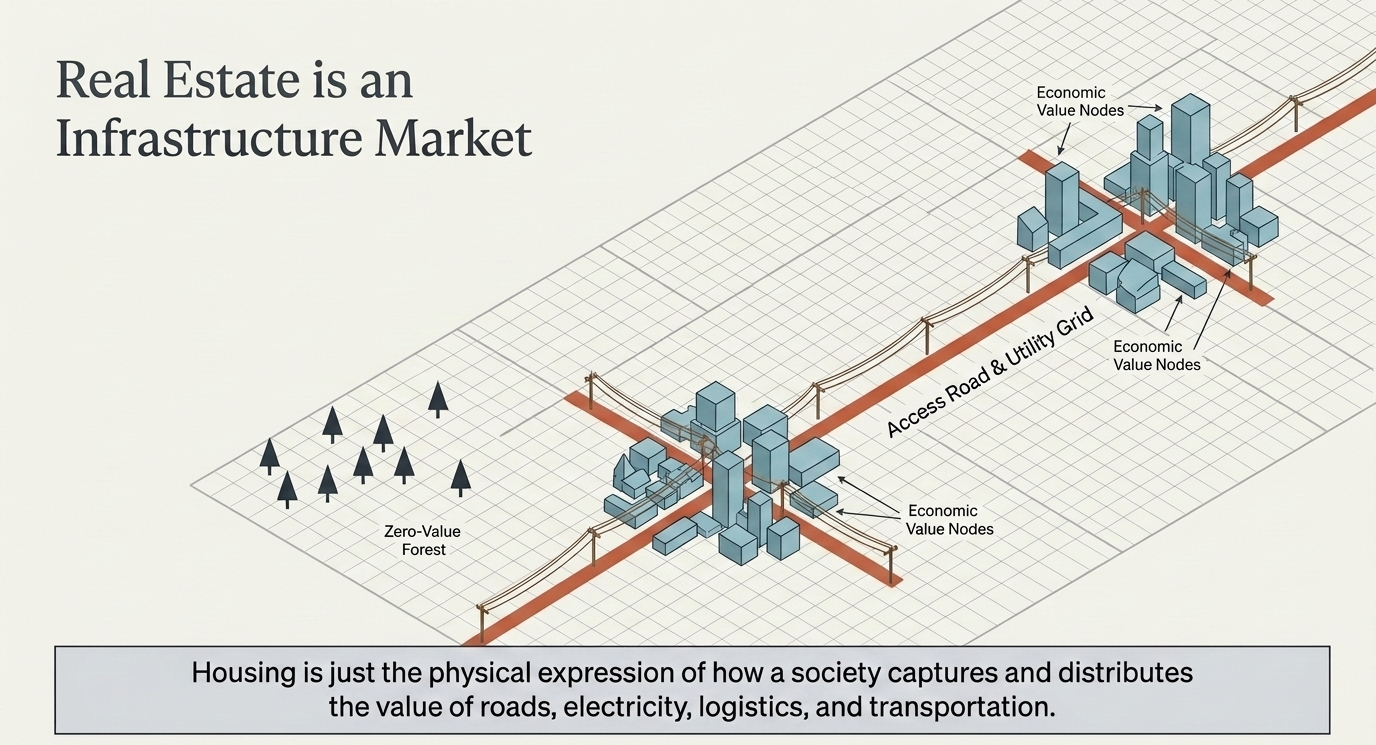
It is infrastructure that creates the value.
Infrastructure creates access → Access creates productivity → Productivity creates value.
… And real estate simply follows that chain.
In many ways, what we call “property value” is often just the monetisation of access. Housing is simply one physical expression of how society captures the value created by infrastructure.
Fun fact: every other point in this article is tied to infrastructure. Check.
Many real estate ‘gurus’ will disagree with me, but… Location means nothing without productivity.
The true driver of value is not a location itself, the productive capacity of the ‘location’ is.
That is productivity.
So instead of blindly chasing “prime locations", it is more important to understand development potential. Because...
Owning expensive land without the capacity to unlock its productive value is often just 'dead' capit disguised as prestige.
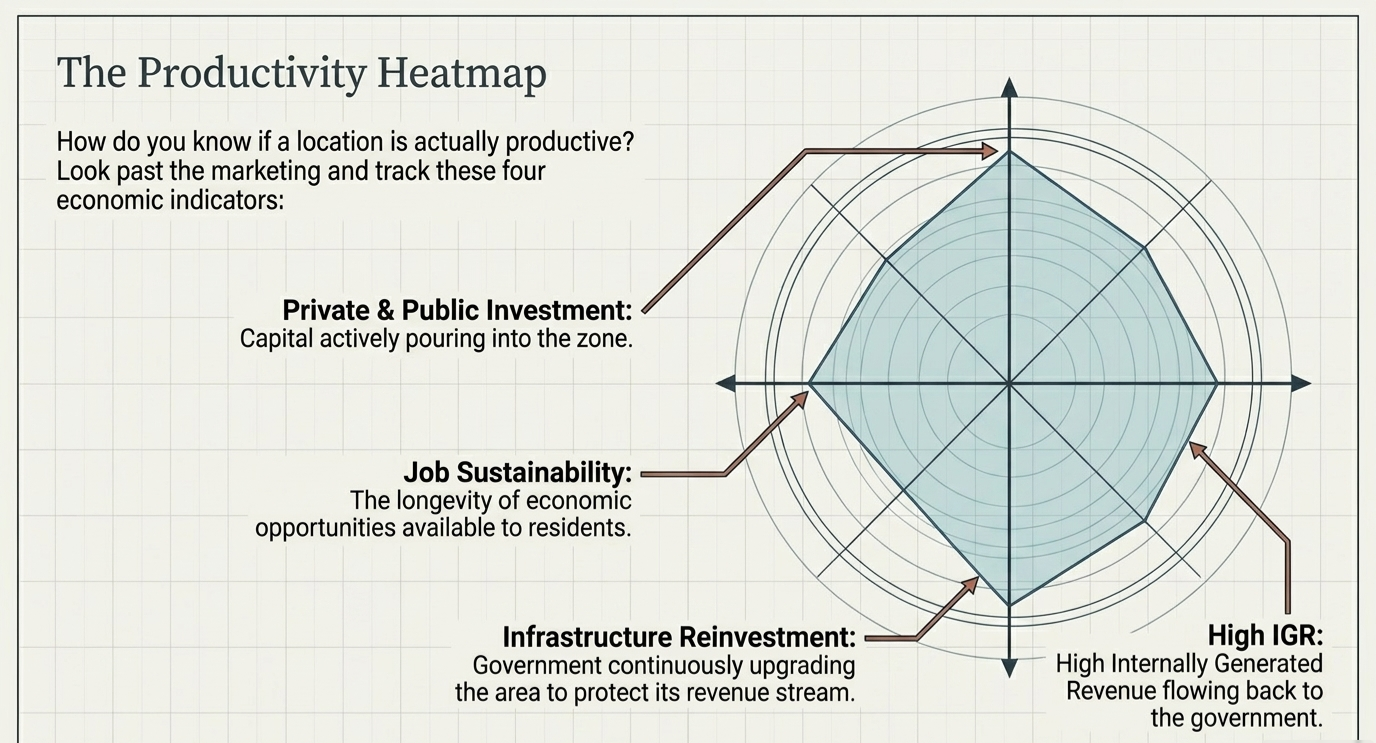
The market is only as strong as the ecosystem supporting it. No ‘investment’ exists in isolation. To understand where the market is leading, you must understand two things:
Everything else sits inside that loop that is the housing ecosystem. That is why everybody says the market is "cyclic".
Planning influences infrastructure → Infrastructure influences productivity → Productivity influences income → Income influences buying power → Buying power influences demand → Demand influences investment behaviour → Investment behaviour reshapes planning → And the cycle continues.
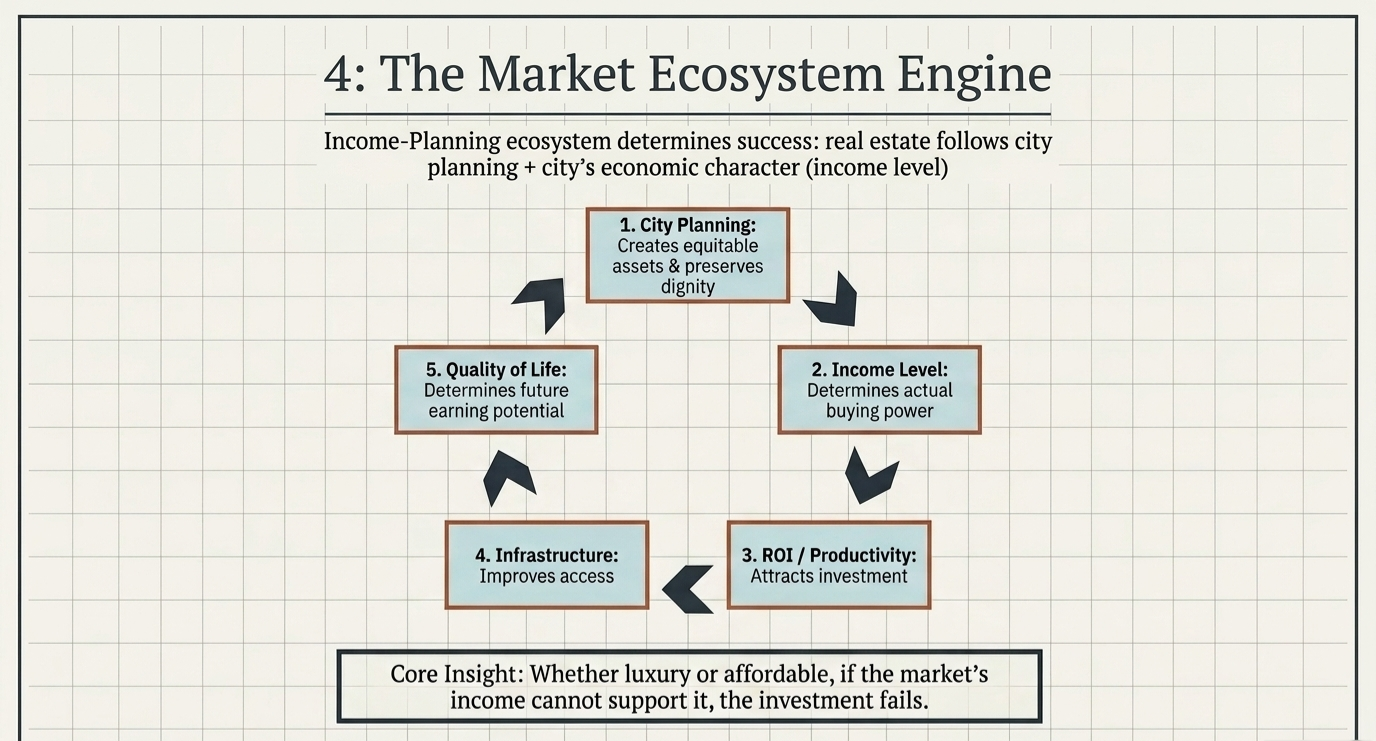
Planning is not merely about master plans or skyscrapers but about:
Every successful "investment" sits quietly in between these.
This is perhaps the hardest truth.
Every "affordable" option involves a trade-off. Right now, the ecosystem isn't strong enough to support true affordable housing, so most current solutions are "work-arounds". And every workaround comes with a trade-off.
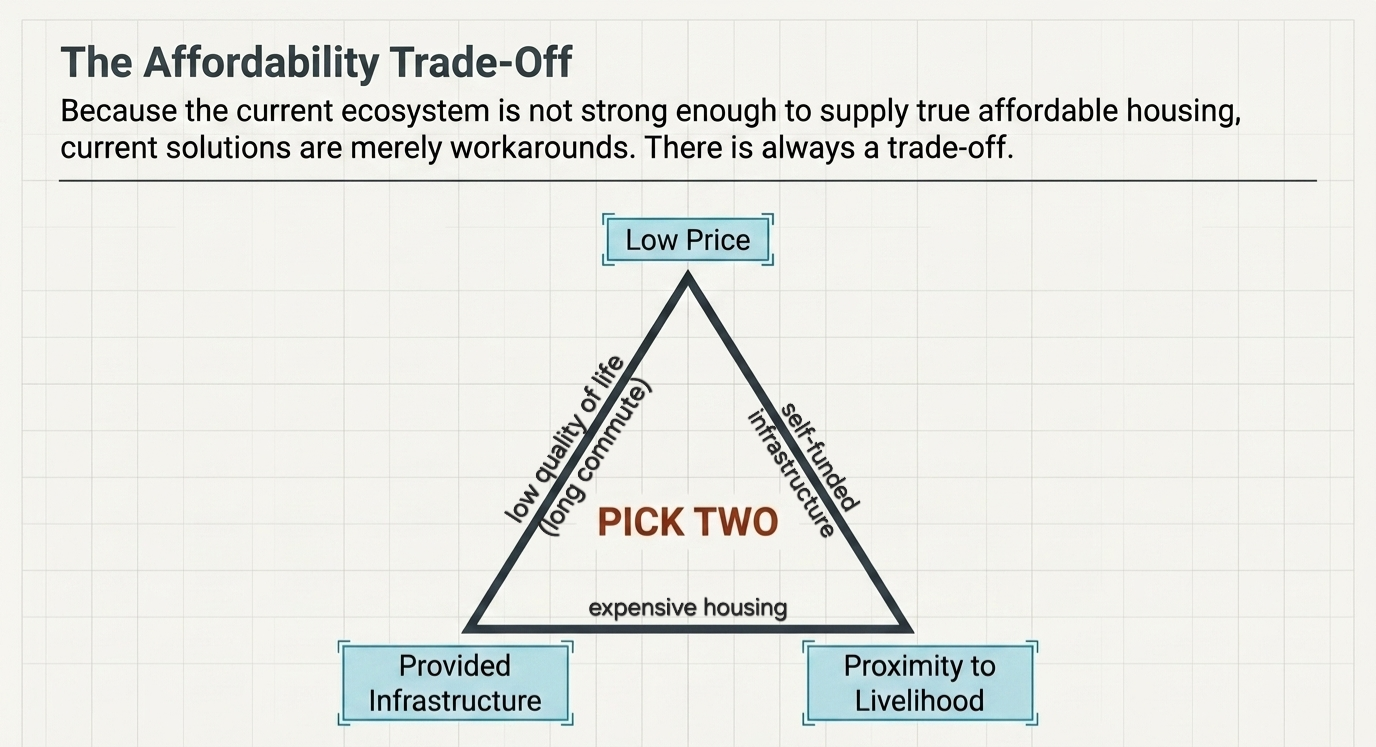
If the house is cheap, it might be far from your job, costing you your quality of life in traffic. If the land is cheap, you may have to pay "development levies" to provide the infrastructure yourself.
Affordability itself is deeply personal. The only person who can truly determine what is affordable is the person paying for it.
Because affordability is about how price interacts with income, family structure, transportation, time, productivity, and quality of life. The responsibility is on you to filter through these "walk-arounds" and decide which trade-offs fit your reality.
True affordability does not come from random “tips and tricks.” It comes from creating systems that allow people to participate in urban opportunities according to their realities.
This is why I keep returning to the same three things:
The real estate market rewards people who understand how value is created, not just people who follow trends. Behind every building, behind every design, construction and/or property development is a deeper system.
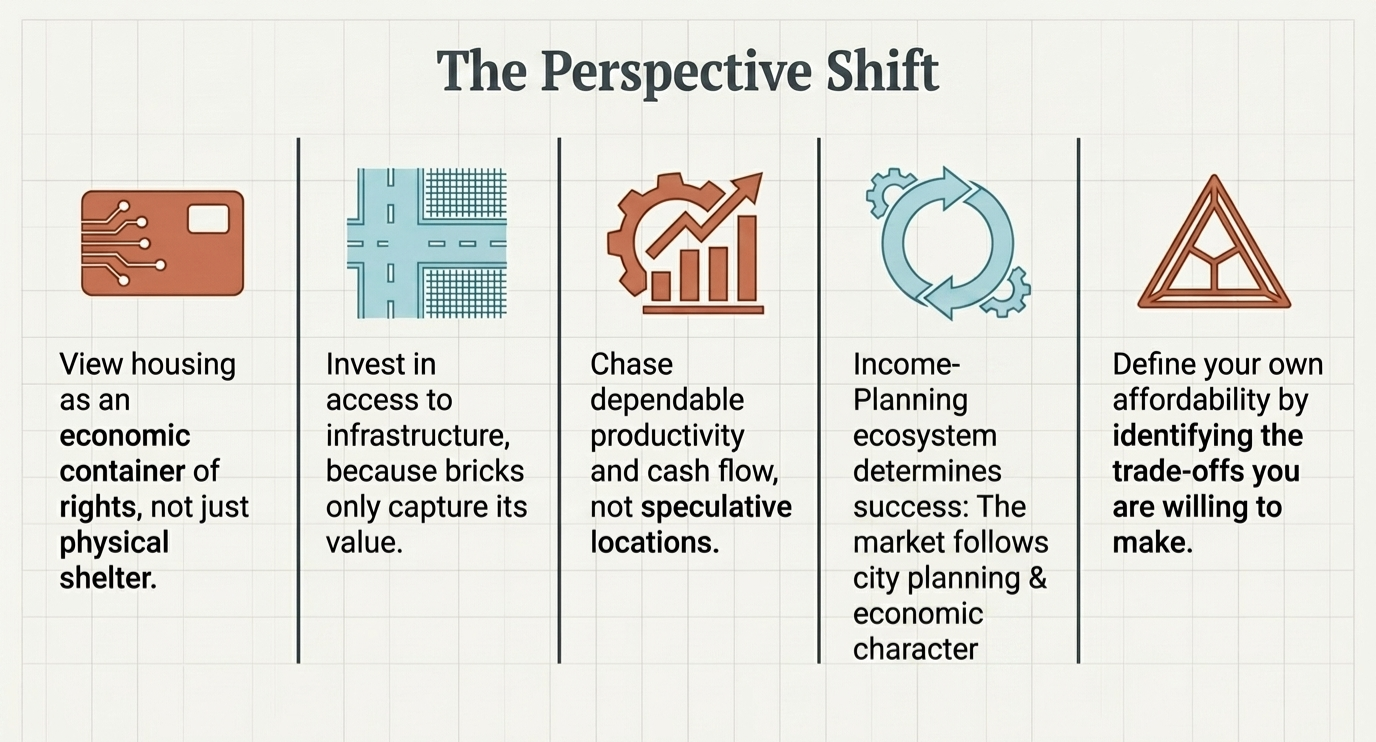
The real struggle… The difference between buying property & actually capturing value is choosing locations, deciding capital-appropriate investments, and development timing.
At PetitHaus, our work goes beyond simply creating access to affordable housing.
What we do is leverage the mechanics behind land, development, affordability, urban growth, for long-term value preservation.
We help you make smarter, more grounded decisions around ownership, development, and investment.
So if you're trying to:
Send a DM, drop a comment, Or Book a consultation right away.
Even if you're still early in the process, sometimes the biggest value is simply understanding what game you're actually playing.
01.

02.
Category
Discover insights into creating affordable homeownership with PetitHaus.







.avif)
.avif)